Same Songs, New Splatter: Inside Britain's Reissue Addiction
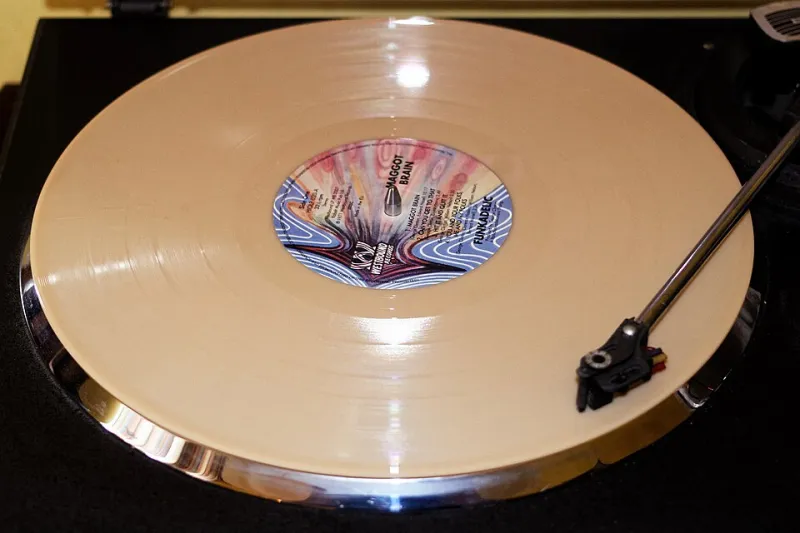
Photo: Retired electrician, CC0, via Wikimedia Commons
Coloured vinyl used to feel like a gift. Now it feels like a schedule. In 2026, a British album announcement is less a reveal than a spreadsheet: the indie-shop splatter, the supermarket clear, the artist-store picture disc, the box set with the demos nobody asked for but every completionist will buy. The deluxe edition is no longer an afterthought. It is the release plan.
That is not a sneer at the format. Vinyl has been one of the few good-news stories in a battered music business, and the ritual of queuing at a independent shop still beats an algorithmic shuffle. But the reissue hustle has become so reliable, so frictionless, that it is starting to look less like a celebration of music and more like a subscription model with a gatefold sleeve.
The variant matrix
Walk into any decent UK record shop and you can see the mechanics at work. A new album arrives in four colours, two of them exclusive to specific retailers, one bundled with a signed print, one pressed on 'eco-mix' vinyl that looks like a melted Quality Street. The fan forum thread starts before the pre-order does: which version has the bonus track, which one ships to Europe, which one is a Rough Trade exclusive, which one is already on eBay at three times face value.
This is not accidental. Variants are a way of selling the same asset to the same person more than once. For labels, the maths is attractive: the recording is already paid for, the artwork is already commissioned, and a second pressing run costs far less than a new artist campaign. For pressing plants, already stretched, it means more short runs and more colour changes. For fans, it means a low-level anxiety that you have somehow bought the wrong version of an album you already own.
Scarcity by design
Manufactured scarcity has become its own genre. A 'limited' run of 500 copies is announced with a countdown timer. The repress arrives six months later, identical except for a minor label variation. Anniversary editions appear at five, ten, twenty and thirty years, each with a new liner note and a slightly worse live recording. Record Store Day, National Album Day and a calendar of label-specific drops have turned the reissue into a seasonal event, complete with queue culture and the familiar sight of sealed copies flipping online before the shop has closed.
None of this is illegal, and much of it is genuinely loved. A well-made box set can be a beautiful object. A bonus disc can illuminate a record you thought you knew. The problem is the proportion. When reissues become the safest bet in the release schedule, they stop being a bonus and start being the business.
Who pays the completionist tax
The cost is not only financial, though it is that too. A £35 LP is a reasonable treat. Four £35 LPs, a £60 box set and a £12 shipping fee is a different proposition. For younger fans, or anyone on a modest budget, the deluxe edition economy creates a hierarchy of fandom: the people who can afford to keep up, and the people who have to choose. The 'exclusive' bonus track becomes a small exclusion of its own.
There is also a less visible cost in attention. Every reissue campaign takes up shelf space, warehouse space and pressing capacity. New artists — especially those on small labels, or outside London, or making music that does not fit a neat vinyl-friendly narrative — are left waiting behind a thirtieth-anniversary repress of an album that already sold millions. The shelf is finite. The pressing plant is finite. The fan's patience is finite too.
The shelf-space problem
This is where the model starts to eat itself. A reissue economy that relies on the same back catalogue can keep the tills ringing, but it cannot keep a scene alive. New music needs risk, and risk needs room. When a label's release schedule is built around coloured variants of known quantities, the unknown quantity gets pushed to the side. The deluxe edition becomes a way of avoiding the harder question: what are we doing for the artists who have not had their first anniversary yet?
None of this means fans should stop buying nice records. It means the hustle should be honest about what it is. If a reissue is a celebration, treat it like one. If it is a cash-flow strategy, at least stop pretending the fourth colourway is a artistic decision. The best reissues open a door onto a record. The worst ones just put a lock on it and sell you the key twice.